Semiconductors are the foundation of modern electronics and are widely used in devices such as diodes, transistors, integrated circuits, solar cells, sensors, and microprocessors. Based on the purity and conductivity characteristics, semiconductors are mainly classified into two types Intrinsic Semiconductor and Extrinsic Semiconductor.
Understanding the difference between intrinsic and extrinsic semiconductors is extremely important in electronics and semiconductor physics because these materials determine how electronic devices behave and perform.
- Related Articles:
- Intrinsic Semiconductors Explained
- Extrinsic Semiconductors Explained
- Energy Band Theory of Solids: Conductors, Semiconductors, and Insulators
- Types of Diodes: Symbol, Working, Characteristics and Applications
Classification of Semiconductors
Semiconductors are classified based on purity, conductivity, and doping characteristics. The two main classifications are Intrinsic Semiconductors and Extrinsic Semiconductors.

Intrinsic Semiconductor
An intrinsic semiconductor is a pure semiconductor material without any intentional impurity atoms added to it. The conductivity of an intrinsic semiconductor depends entirely on the thermally generated electrons and holes present inside the crystal.

The most common intrinsic semiconductor materials are Silicon (Si) and Germanium (Ge).
- In intrinsic semiconductors:
- Number of free electrons = Number of holes
- Electrical conductivity is low
- Current conduction occurs due to thermally generated charge carriers
At absolute zero temperature, intrinsic semiconductors behave almost like insulators.
Extrinsic Semiconductor
An extrinsic semiconductor is a semiconductor material whose electrical conductivity is intentionally increased by adding controlled impurities into the pure semiconductor crystal. This process is known as doping. The added impurity atoms are called dopants.

Extrinsic semiconductors are classified into N-Type Semiconductor and P-Type Semiconductor. The addition of impurities significantly increases conductivity by increasing the number of free charge carriers.
N-Type Semiconductor
Formed by adding pentavalent impurities such as Phosphorus, Arsenic, Antimony.
- Electrons are majority charge carriers
- Higher conductivity than intrinsic semiconductors
P-Type Semiconductor
Formed by adding trivalent impurities such as Boron, Gallium, Indium.
- Holes are majority charge carriers
- Conductivity mainly due to hole movement
Difference Between Intrinsic and Extrinsic Semiconductor
Structure of Intrinsic Semiconductor
- In an intrinsic semiconductor:
- Every atom forms a covalent bond with neighboring atoms.
- No extra free electrons are intentionally introduced.
- Thermal energy breaks some covalent bonds and creates electron-hole pairs.
- When temperature increases:
- More covalent bonds break
- More free charge carriers are generated
- Conductivity increases
Structure of Extrinsic Semiconductor
In extrinsic semiconductors, impurity atoms are added to increase conductivity. Two types of impurities are used:
- Pentavalent Impurities
- Phosphorus
- Arsenic
- Antimony
These impurities have 5 valence electrons and create N-type semiconductor with extra free electrons.
- Trivalent Impurities
- Boron
- Gallium
- Indium
These impurities have 3 valence electrons and create P-type semiconductor with Holes.
Working Principle of Intrinsic Semiconductor
In intrinsic semiconductors, conduction occurs due to thermal generation of electron-hole pairs.
- When thermal energy is applied:
- Electrons gain energy
- Electrons move from valence band to conduction band
- Holes are left behind in the valence band
The number of free electrons or holes present in an intrinsic semiconductor is called intrinsic carrier concentration.
ni = pi
- ni = Electron concentration
- pi = Hole concentration
For intrinsic semiconductors number of electrons equals number of holes.
Working Principle of Extrinsic Semiconductor
Extrinsic semiconductors conduct electricity mainly through majority charge carriers introduced by doping.
In N-Type Semiconductor
- Pentavalent impurity adds extra electrons
- Electrons become majority carriers
- Holes become minority carriers
The conductivity becomes much higher than intrinsic material.
In P-Type Semiconductor
- Trivalent impurity creates holes
- Holes become majority carriers
- Electrons become minority carriers
Current conduction mainly occurs due to hole movement.
Energy Band Diagram Difference
Intrinsic Semiconductor
- Fermi level lies approximately at the center of the band gap.
- Equal probability of electrons and holes.

Extrinsic Semiconductor
- N-Type: Fermi level shifts closer to conduction band.
- P-Type: Fermi level shifts closer to valence band.
- This shift increases conductivity significantly.
Conductivity Difference
The conductivity of semiconductors is given by:
σ = q(nμn + pμp)
- σ = Conductivity
- q = Electronic charge
- n = Electron concentration
- p = Hole concentration
- nμn = Electron mobility
- pμp = Hole mobility
- In extrinsic semiconductors:
- Carrier concentration becomes very high
- Conductivity increases drastically
For intrinsic semiconductors ni = pi
σ = qni(μn + μp)
An intrinsic semiconductor is a pure semiconductor material without any significant impurity atoms added. Common examples are Silicon and Germanium in their pure form.
Advantages of Intrinsic Semiconductors
- High Purity
- Since no intentional impurities are added, the crystal structure remains highly pure and uniform.
- This makes intrinsic semiconductors useful for studying fundamental semiconductor behavior.
- Equal Electron and Hole Concentration
- The number of free electrons equals the number of holes.
- This balanced charge carrier distribution simplifies theoretical analysis.
- Good Thermal Sensitivity
- Conductivity changes significantly with temperature.
- Useful in temperature-sensing devices such as thermistors.
- Simple Manufacturing Concept
- No doping process is required.
- Easier to understand and model in semiconductor physics.
- Foundation for Semiconductor Theory
- Intrinsic semiconductors are the basis for understanding carrier generation, recombination, and band theory.
Disadvantages of Intrinsic Semiconductors
- Low Electrical Conductivity
- Pure semiconductors have very few free charge carriers at room temperature.
- Hence, they conduct electricity poorly compared to doped semiconductors.
- Strong Temperature Dependence
- Conductivity changes rapidly with temperature.
- This can make device performance unstable in varying environments.
- Limited Practical Applications
- Most electronic devices require higher conductivity and controlled carrier concentration.
- Therefore, extrinsic semiconductors are preferred in practical electronics.
- Not Suitable for High-Speed Devices
- Due to lower carrier concentration, intrinsic semiconductors are slower and less efficient for advanced circuits.
- Difficult to Control Electrical Properties
- Since there is no doping, tuning conductivity precisely is difficult.
Advantages of Extrinsic Semiconductors
- Higher Electrical Conductivity
- Doping introduces additional free charge carriers (electrons or holes).
- This greatly increases electrical conductivity compared to intrinsic semiconductors.
- Controlled Conductivity
- The conductivity can be precisely controlled by adjusting the amount and type of impurity added.
- This makes extrinsic semiconductors highly suitable for electronic device design.
- Suitable for Electronic Devices
- Most modern electronic components such as diodes, transistors, and integrated circuits use extrinsic semiconductors.
- They provide the required current flow and switching behavior.
- Faster Device Performance
- Higher carrier concentration allows quicker charge movement.
- This improves the speed and efficiency of semiconductor devices.
- Lower Temperature Sensitivity
- Extrinsic semiconductors are less affected by temperature changes than intrinsic semiconductors.
- This provides more stable operation in practical applications.
- Availability of n-type and p-type Materials
- Doping allows formation of:
- n-type semiconductors (electron majority carriers)
- p-type semiconductors (hole majority carriers)
- These are essential for creating PN junction devices.
- Doping allows formation of:
Disadvantages of Extrinsic Semiconductors
- Impurity Introduction
- Doping adds foreign atoms into the crystal lattice.
- This reduces the purity of the semiconductor material.
- Complex Manufacturing Process
- Precise doping techniques are required during fabrication.
- This increases production complexity and cost.
- Possibility of Crystal Defects
- Improper doping may create defects or irregularities in the crystal structure.
- These defects can affect device performance.
- Reduced Mobility
- Impurity atoms can scatter charge carriers.
- As a result, carrier mobility may decrease compared to intrinsic semiconductors.
- Thermal Noise and Leakage Current
- At high temperatures, extrinsic semiconductors may exhibit leakage currents and increased thermal noise.
- This can reduce device reliability.
- Difficult Doping Control at Nano Scale
- In very small semiconductor devices, maintaining accurate impurity concentration becomes challenging.
- Minor variations can significantly affect performance.
Applications of Intrinsic Semiconductor
- Semiconductor Research: Used for studying charge carriers, conductivity, and semiconductor behavior.
- Material Characterization: Used to analyze purity, crystal structure, and electrical properties of semiconductor materials.
- Educational Demonstrations: Used in laboratories to demonstrate semiconductor principles and energy band theory.
- Temperature Sensing Devices: Used in thermistors and heat-control systems due to high temperature sensitivity.
- Photodetectors: Used in light sensors and photodiodes because conductivity increases when exposed to light.
Applications of Extrinsic Semiconductor
- Diodes: Used for rectification, switching, and signal detection in electronic circuits.
- Transistors: Used for amplification and switching operations in electronic devices.
- MOSFETs: Used in high-speed switching and power control applications.
- Integrated Circuits (ICs): Used in compact electronic circuits containing multiple components on a single chip.
- Solar Cells: Used for converting solar energy into electrical energy.
- LEDs: Used in display systems and lighting applications by emitting light when current flows.
- Rectifiers: Used for converting alternating current (AC) into direct current (DC).
- Logic Gates: Used in digital electronics to perform logical operations.
- Microprocessors and Mircrocontrollers: Used in computers and smart devices for data processing and control.
- Communication Systems: Used in signal transmission, modulation, and communication equipment.
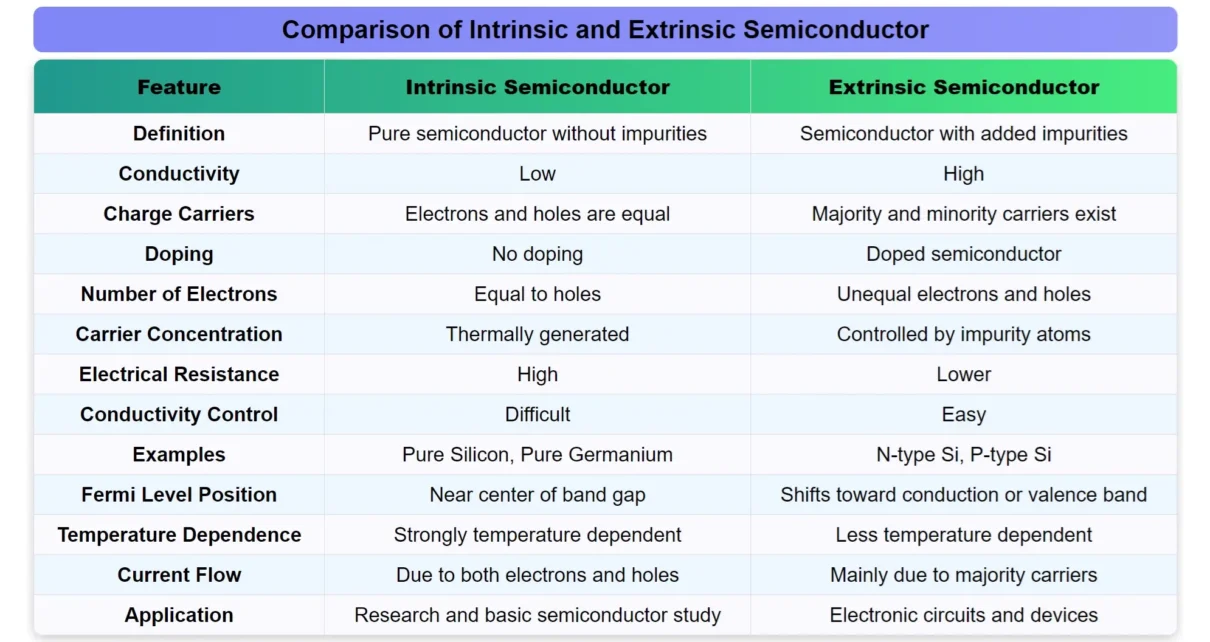
Comparison of Intrinsic and Extrinsic Semiconductors
| Feature | Intrinsic Semiconductor | Extrinsic Semiconductor |
|---|---|---|
| Definition | Pure semiconductor without impurities | Semiconductor with added impurities |
| Conductivity | Low | High |
| Charge Carriers | Electrons and holes are equal | Majority and minority carriers exist |
| Doping | No doping | Doped semiconductor |
| Number of Electrons | Equal to holes | Unequal electrons and holes |
| Carrier Concentration | Thermally generated | Controlled by impurity atoms |
| Electrical Resistance | High | Lower |
| Conductivity Control | Difficult | Easy |
| Examples | Pure Silicon, Pure Germanium | N-type Si, P-type Si |
| Fermi Level Position | Near center of band gap | Shifts toward conduction or valence band |
| Temperature Dependence | Strongly temperature dependent | Less temperature dependent |
| Current Flow | Due to both electrons and holes | Mainly due to majority carriers |
| Application | Research and basic semiconductor study | Electronic circuits and devices |
Conclusion
Intrinsic and extrinsic semiconductors are the two fundamental classifications of semiconductor materials. Extrinsic semiconductors are intentionally doped to increase conductivity and improve device performance, while intrinsic semiconductors are pure materials with low conductivity and equal electron-hole concentration.
Intrinsic vs Extrinsic Semiconductor:
- Purity
- Intrinsic semiconductors are pure.
- Extrinsic semiconductors contain impurities.
- Conductivity
- Intrinsic semiconductors have low conductivity.
- Extrinsic semiconductors have high conductivity.
- Charge Carriers
- Intrinsic: equal electrons and holes
- Extrinsic: majority and minority carriers
- Doping
- Intrinsic: no doping
- Extrinsic: intentionally doped
- Practical Usage
- Intrinsic: mainly theoretical and research use
- Extrinsic: widely used in practical electronics
Modern electronic systems primarily rely on extrinsic semiconductors because controlled doping allows engineers to create efficient devices such as diodes, transistors, integrated circuits, LEDs, and microprocessors. Understanding the difference between intrinsic and extrinsic semiconductors is essential for studying semiconductor electronics, solid-state devices, and electrical engineering.
Energy Band Theory of Solids: Conductors, Semiconductors, and Insulators
Types of Diodes: Symbol, Working, Characteristics and Applications
Rectifier Circuit: Construction, Working, Types and Applications

