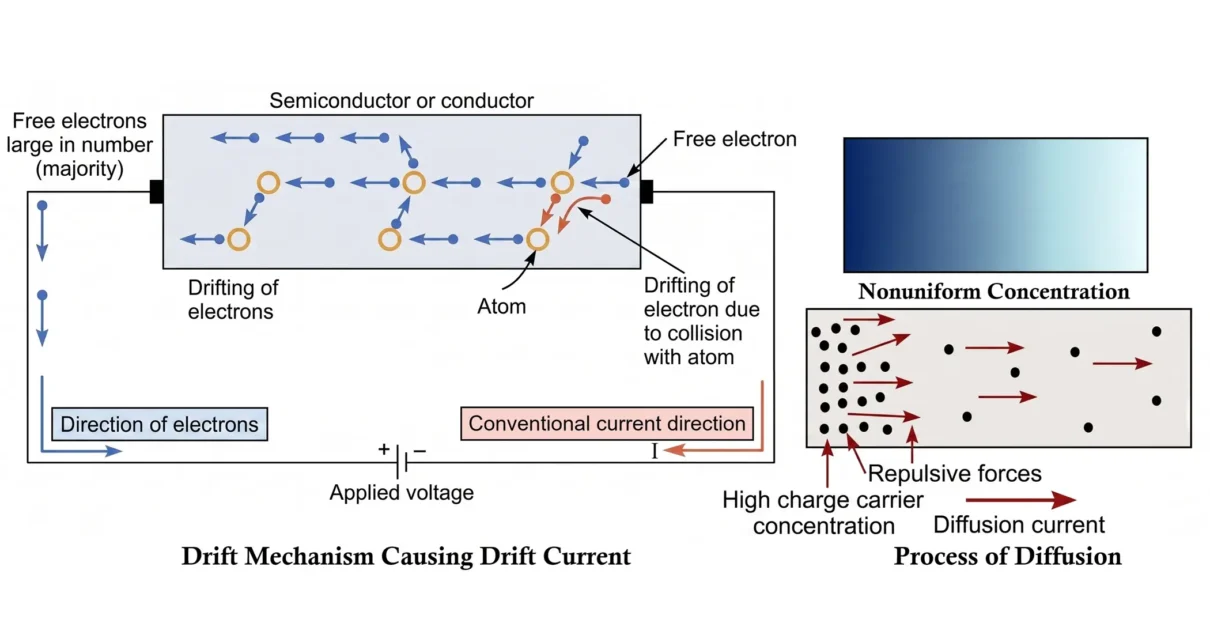
Drift current and diffusion current are two fundamental mechanisms of charge transport in semiconductors. These concepts form the basis of semiconductor physics and are extremely important for understanding the operation of devices such as p-n junction diodes, transistors, LEDs, solar cells, MOSFETs, and integrated circuits. In semiconductors, electric current is produced not only by the […]
Tag: Semiconductor Materials
Difference Between Intrinsic and Extrinsic Semiconductor
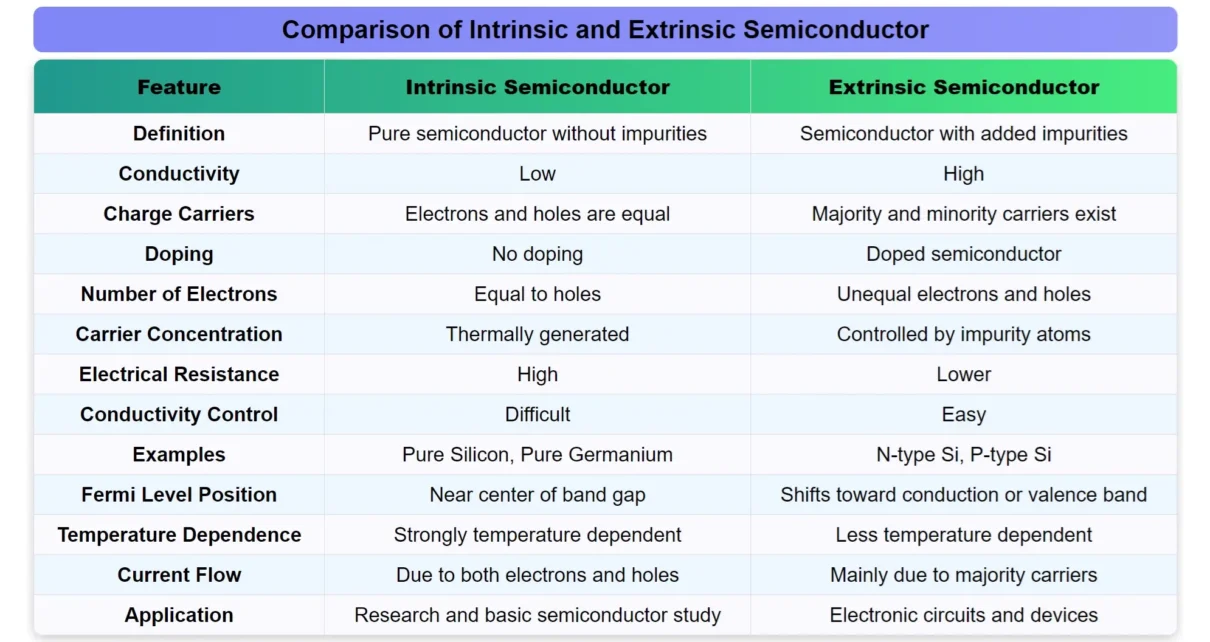
Semiconductors are the foundation of modern electronics and are widely used in devices such as diodes, transistors, integrated circuits, solar cells, sensors, and microprocessors. Based on the purity and conductivity characteristics, semiconductors are mainly classified into two types Intrinsic Semiconductor and Extrinsic Semiconductor. Understanding the difference between intrinsic and extrinsic semiconductors is extremely important in […]
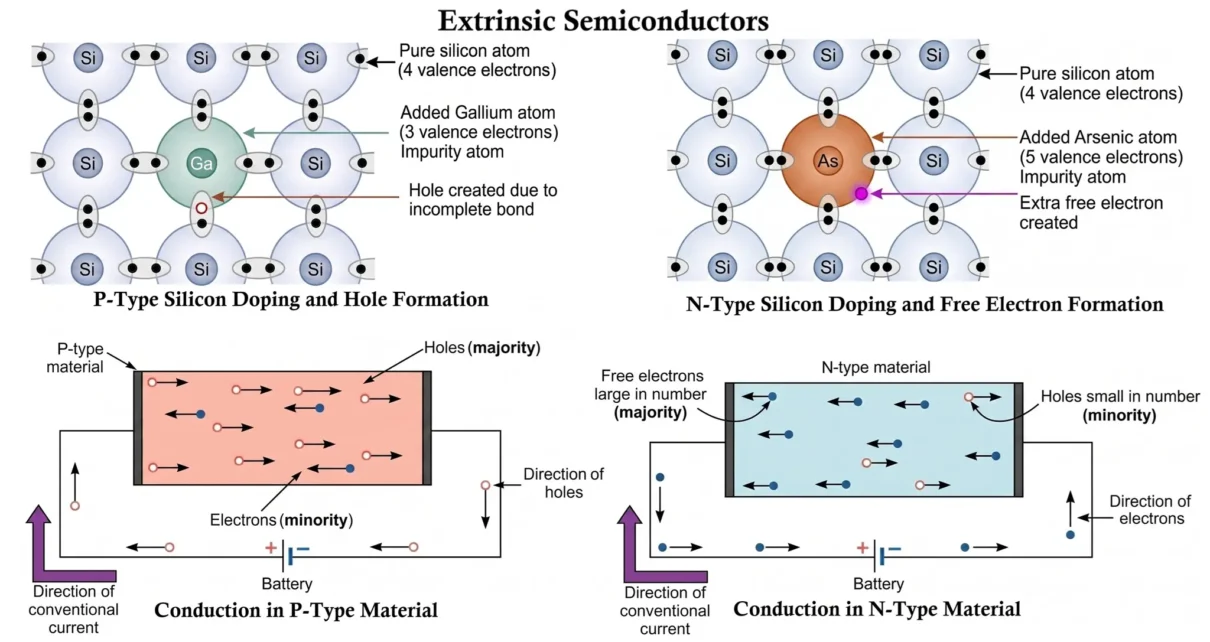
Extrinsic Semiconductors Explained
An extrinsic semiconductor is a semiconductor material whose electrical conductivity is intentionally increased by adding a small amount of impurity atoms into a pure semiconductor crystal. This process is known as doping. Extrinsic semiconductors form the foundation of modern electronics and are widely used in diodes, transistors, integrated circuits, LEDs, solar cells, and microprocessors. Pure […]
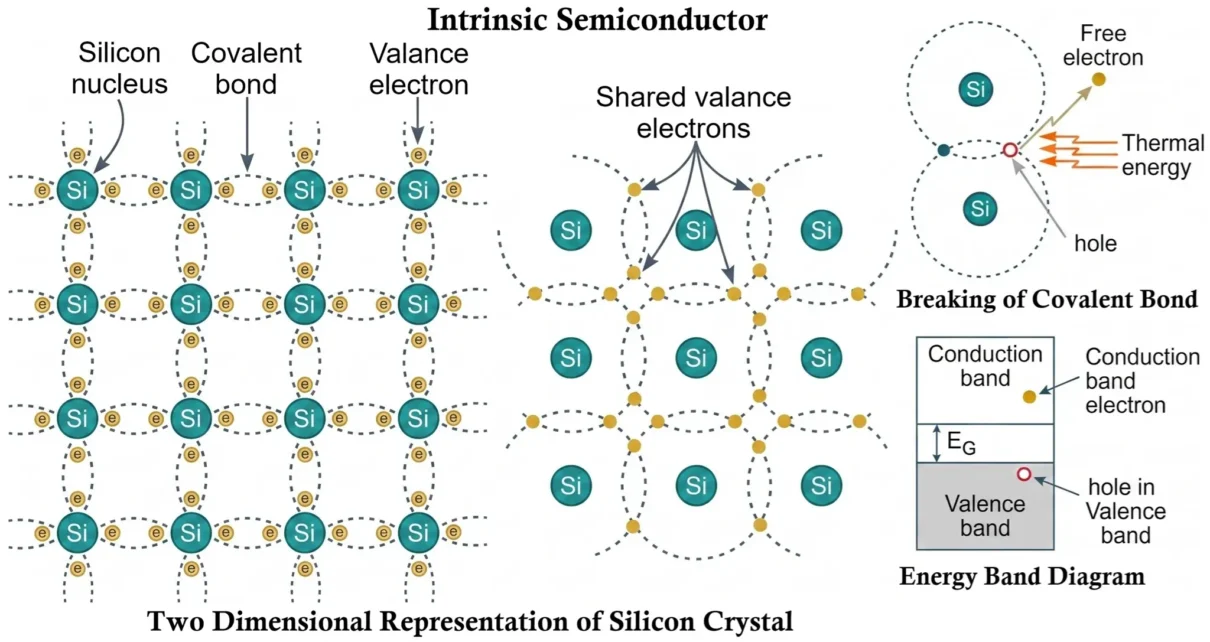
Intrinsic Semiconductors Explained
In this article, we will explore intrinsic semiconductors, including their definition, crystal structure, energy band diagram, characteristics, advantages, disadvantages, and applications. An intrinsic semiconductor is a pure semiconductor material without any significant impurity atoms added to it. In intrinsic semiconductors, the number of free electrons and holes are naturally generated due to thermal energy and […]