In our increasingly digital world, printed circuit boards (PCBs) are the silent workhorses powering virtually every electronic device we encounter, from the smartphone in your pocket to the complex systems guiding satellites. FR-4 PCB material forms the core of most printed circuit boards. Often going unnoticed, FR-4 is the fundamental substrate that provides the strength, electrical insulation, and reliability engineers depend on. This versatile fiberglass-reinforced epoxy material has become the industry standard due to its balanced properties and cost-effectiveness.
What Exactly is FR-4 Material?
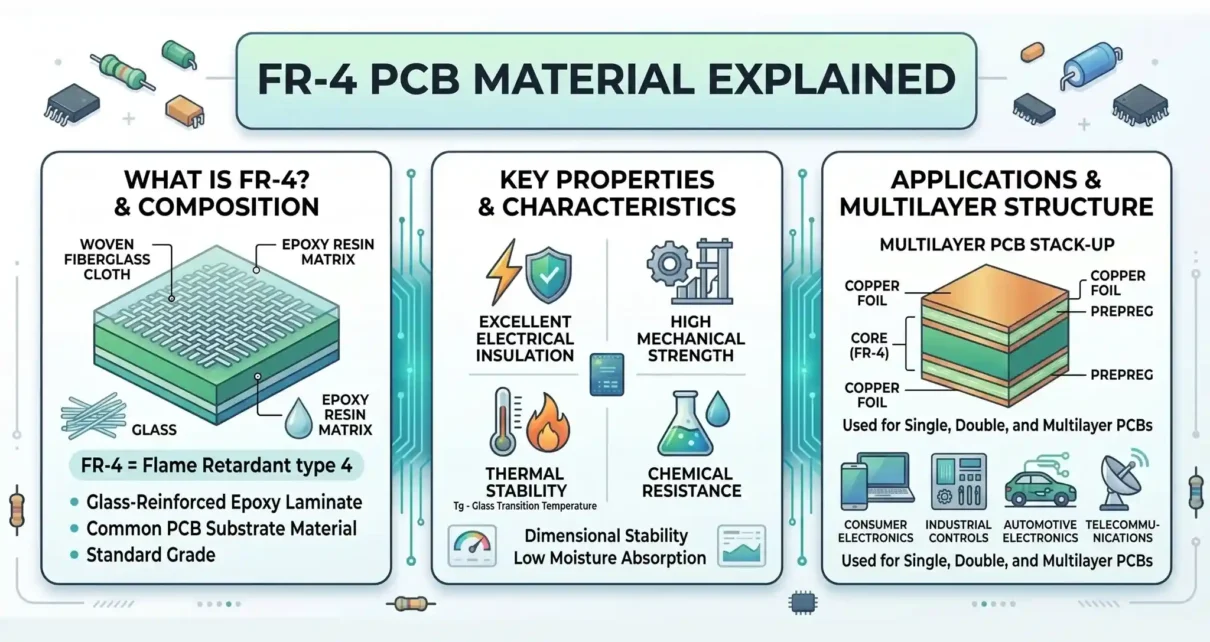
FR-4 is a widely used composite material that serves as the dielectric layer in the vast majority of printed circuit boards. It ’s essentially a laminate created by combining woven fiberglass cloth with a flame-retardant epoxy resin. This combination gives FR-4 its distinctive properties: high mechanical strength provided by the fiberglass and excellent electrical insulation from the epoxy resin.
The role of FR-4 is critical in PCB construction. It separates the conductive copper layers, preventing short circuits, while also providing robust mechanical support to the entire board and its mounted components. Without a stable and insulating foundation like FR- 4, the intricate network of traces and components on a PCB would be unable to function reliably.
Related Articles:
- PCB Manufacturing and Assembly Process
- Types of PCB Materials Their Properties and Applications
- How to Assemble Electronic Components on a PCB
- Cost-Effective Overseas PCB Services for Small Businesses
- Revolutionary Axial Flux Printed Circuit Board (PCB) Stator Motor
- High Speed PCB Design: Routing, Impedance & Layout Techniques
- What are the Key Stages in Aluminum PCB Manufacturing?
What “FR-4” Means
The name “FR-4” isn’t just a random designation; it carries specific meaning related to the material’s composition and classification:
- FR: This is an abbreviation for “Flame Retardant.” It signifies that the material meets specific standards for fire resistance, primarily the UL94V-0 standard for plastic material inflammability. This means FR-4 is designed to resist burning and will self-extinguish if ignited, a crucial safety feature in electronics. The flame-retardant properties are often achieved by incorporating halogens like Bromine into the epoxy resin.
- 4: This number indicates the material’s grade within a family of glass epoxy laminate materials. It’ s a designation originally set by the National Electrical Manufacturers Association (NEMA), an organization that sets technical standards for electrical products.
Thus, FR-4 isn’t just a generic term but a specific classification for a flame-retardant, glass-reinforced epoxy laminate material widely recognized and standardized across the electronics manufacturing industry.
Key Properties That Make FR-4 an Industry Standard
FR-4’s widespread adoption stems from its balanced blend of critical properties, making it suitable for a broad range of applications:

- Excellent Electrical Insulation: The epoxy resin component of FR-4 provides superb dielectric strength, effectively isolating different conductive layers and traces on the PCB. This prevents electrical shorts and ensures signals travel along their intended paths without interference. Its dielectric constant (Dk) and dissipation factor (Df) are generally stable enough for most general-purpose applications.
- High Mechanical Strength: The woven fiberglass cloth gives FR-4 exceptional rigidity and structural integrity. This allows PCBs to withstand mechanical stress during manufacturing (e.g., component placement, soldering) and throughout their operational life, ensuring components remain securely mounted and the board doesn’t warp.
- Thermal Endurance: While not a high-temperature specialist, standard FR-4 offers adequate thermal performance for most consumer and industrial electronics. A key thermal characteristic is its Glass Transition Temperature (Tg), which is the point at which the epoxy resin transitions from a rigid, glassy state to a softer, rubbery state. Typical FR-4 boards have a Tg around 135°C, though higher Tg variants exist for more demanding applications.
- Flame Retardancy: As indicated by its name, FR-4 is designed to be flame retardant, meeting the UL94V-0 standard. This means it will stop burning within 10 seconds on a vertical part and won’t produce flaming drips, enhancing the safety of electronic devices. This is a crucial property for product certification and consumer safety.
- Chemical Resistance: FR-4 exhibits good resistance to various chemicals commonly encountered during PCB manufacturing and in certain operating environments, contributing to its durability and longevity.
- Cost-Effectiveness: Compared to many specialized PCB materials, FR-4 is significantly more economical to produce and process, making it an attractive choice for mass-produced electronics.
Why FR-4 Dominates PCB Manufacturing

The pervasive use of FR-4 in PCB manufacturing isn’t accidental. Its dominance is a result of several compelling advantages:
- Vers atility: FR-4’s balanced properties make it suitable for a vast array of electronic devices, from simple single-layer boards to complex multi-layer designs. This versatility reduces the need for specialized materials in many standard applications.
- Ease of Manufacturing: FR-4 is relatively easy to process during PCB fabrication. It can be readily drilled, routed, and plated using standard manufacturing equipment and techniques. This contributes to lower production costs and faster turnaround times .
- Reliability: Decades of use have proven FR-4’s reliability. Its stable properties ensure consistent performance over time, reducing failures in electronic products.
- Wide Availability: Given its status as an industry standard, FR-4 material is globally available from numerous suppliers, ensuring a robust supply chain for manufacturers. This widespread availability also drives competitive pricing.
- Excellent Balance of Properties: While specialized materials might excel in one particular property (e.g., high-frequency performance or extreme thermal resistance), FR-4 provides an excellent balance of electrical, mechanical, and thermal performance, making it a cost-effective choice across all key parameters.
Common FR-4 Specifications: Thickness and Tg Ratings
While FR-4 is a standard, it’s not a monolithic material. Manufacturers offer variations to meet specific design requirements. Two common specifications that differentiate FR-4 materials are thickness and Glass Transition Temperature (Tg) ratings.
FR-4 Thickness Options:
PC Bs come in a variety of thicknesses, with FR-4 accommodating most standard options. The thickness is crucial for the mechanical stability of the board and for controlling impedance in high-speed designs. Common thickness options range from very thin to quite thick:
- 0.2mm (approximately 0.008 inches)
- 0.4mm (approximately 0.016 inches)
- 0.8mm (approximately 0.031 inches)
- 1.0mm (approximately 0.039 inches)
- 1.2mm (approximately 0.047 inches)
- 1.6mm (approximately 0.063 inches) – Most common and standard thickness.
- 2.0mm (approximately 0.079 inches)
- 2.4mm (approximately 0.094 inches)
- 3.2mm (approximately 0.126 inches)
The choice of thickness depends on factors like the board size, the number of layers, the weight of components, and mechanical stress considerations.
FR-4 Tg Ratings:
As mentioned, Tg (Glass Transition Temperature) is a critical thermal property. Standard FR-4 typically has a Tg of 135°C. However, for applications requiring higher thermal stability, such as those involving more intense heat cycles (e.g., lead-free soldering processes, high-power components), higher Tg FR-4 materials are available.
| FR-4 Type | Typical Tg Value | Application Considerations |
|---|---|---|
| Standard Tg FR-4 | ~135° C | General-purpose electronics, leaded soldering processes, lower operating temperatures. |
| Mid-Tg FR-4 | ~150°C | Improved thermal performance, suitable for some lead-free applications, moderate heat environments. |
| High-Tg FR-4 | ~170°C and higher | Demanding applications, high-density interconnect (HDI) PCBs, lead-free soldering, high operating temperatures, automotive, aerospace. |
Selecting the correct Tg rating is vital to prevent delamination, warping, and other thermal-induced failures, especially as operating temperatures and soldering temperatures increase.
Where Do We Find FR-4 PCBs? Ubiquitous Applications
The versatility and cost-effectiveness of FR-4 mean that FR4 PCB boards are found virtually everywhere electronics exist. Some common applications include:
- Consumer Electronics: Smartphones, tablets, laptops, televisions, gaming consoles, digital cameras, and home appliances all commonly utilize FR-4 PCBs.
- Computers and Peripherals: Mother boards, graphics cards, network cards, and other components within desktop computers and servers frequently use FR-4.
- Industrial Equipment: Control systems, power supplies, automation machinery, and test equipment often rely on the durability and reliability of FR-4.
- Automotive Electronics: While some automotive applications might require specialized high-temperature materials, many non-critical electronic modules within vehicles still use FR-4.
- Medical Devices : A wide range of medical diagnostic and treatment devices incorporate FR-4 PCBs, leveraging its consistent performance.
- LED Lighting: Control circuits for LED lighting systems, from residential fixtures to commercial installations, are often built on FR -4.
- DIY and Prototyping: Due to its accessibility and ease of use, FR-4 is the material of choice for hobbyists, students, and engineers developing prototypes.
This extensive list underscores FR-4’s fundamental role as the bedrock of modern electronic devices.
FR-4 vs. Alternative PCB Substrates
While FR-4 is the industry benchmark for most PCBs, engineers sometimes consider alternative PCB substrate materials for specific, high-performance needs. Each material has its strengths and trade-offs in terms of thermal endurance, electrical performance, and cost efficiency.
- Polyimide: This material offers superior thermal performance and mechanical strength, especially at higher temperatures. It’s often chosen for flexible PCBs (Flex PCBs) or rigid-flex boards where bending and extreme temperatures are factors. However, poly imide is significantly more expensive than FR-4.
- Rogers/PTFE-based Materials: These specialized materials are known for their excellent high-frequency characteristics, lower dielectric loss, and stable dielectric constant over a wide temperature range. They are ideal for RF (Radio Frequency), microwave, and high-speed digital applications where signal integrity is paramount, such as in 5G infrastructure. Rogers materials are considerably more expensive and often harder to process than FR -4.
- Metal-Core PCBs (MCPCBs): For applications requiring exceptional heat dissipation, such as high-power LEDs or motor controllers, MCPCBs use a metal base (like aluminum or copper) instead of or in addition to FR-4. While they excel in thermal management, their electrical insulation properties might differ, and they are typically heavier and more specialized.
- CEM (Composite Epoxy Material): CEM materials are similar to FR-4 but often use a combination of woven and non-woven fiberglass or paper. They are generally less expensive than FR-4 but may have slightly inferior mechanical or electrical properties, sometimes used for single -sided or less demanding double-sided boards.
FR-4’s enduring appeal lies in its ability to offer a robust and cost-effective solution for a vast majority of electronic designs, while these alternatives fill niches where its properties might fall short.
FAQ About FR-4 PCBs
Question 1: Is FR-4 environmentally friendly?
Answer: Standard FR-4 contains bromine, a halogen, for its flame retardant properties. While effective, there’s a growing movement towards halogen-free FR-4 alternatives to address environmental concerns, particularly regarding recycling and potential toxic emissions during incineration.
Question 2: Can FR-4 be used for high-frequency applications?
Answer: For general-purpose high-frequency applications (e.g., Wi-Fi, Bluetooth at lower GHz ranges), FR-4 can sometimes be used with careful design. However, for critical high-speed digital, RF, and microwave applications, its dielectric properties (higher dissipation factor, less stable dielectric constant) become a limiting factor. Specialized materials like Rogers are preferred for such scenarios.
Question 3: What is the difference between standard FR-4 and high-Tg FR-4?
Answer: The primary difference is the Glass Transition Temperature (Tg ). Standard FR-4 typically has a Tg of around 135°C, while high-Tg FR-4 has a Tg of 170°C or higher. High-Tg materials offer better thermal stability and resistance to del amination, especially important for lead-free soldering processes and high-power applications where the board experiences more heat.
Question 4: Why is FR-4 so common for prototyping?
Answer: FR -4 is the go-to choice for prototyping due to its low cost, wide availability, and ease of fabrication. It allows engineers and hobbyists to quickly and affordably test designs without investing in more expensive, specialized materials until performance requirements are fully validated.
Summary: The Enduring Legacy of FR-4
FR-4 is undeniably the backbone of the modern electronics industry. As a composite of woven fiberglass cloth and flame-retard ant epoxy resin, it provides an exceptional balance of mechanical strength, electrical insulation, and thermal stability. Its “FR” designation highlights its crucial flame-retardant properties, meeting the UL94V-0 standard, while the “4” signifies its NEMA classification. From standard consumer electronics to robust industrial controls, FR-4’s versatility, ease of manufacturing, and cost-effectiveness have cemented its status as the default PCB substrate.
What Makes Overseas PCB Services Cost-Effective for Small Businesses
Revolutionary Axial Flux Printed Circuit Board (PCB) Stator Motor
High Speed PCB Design: Essential Wiring Techniques for Optimal Performance