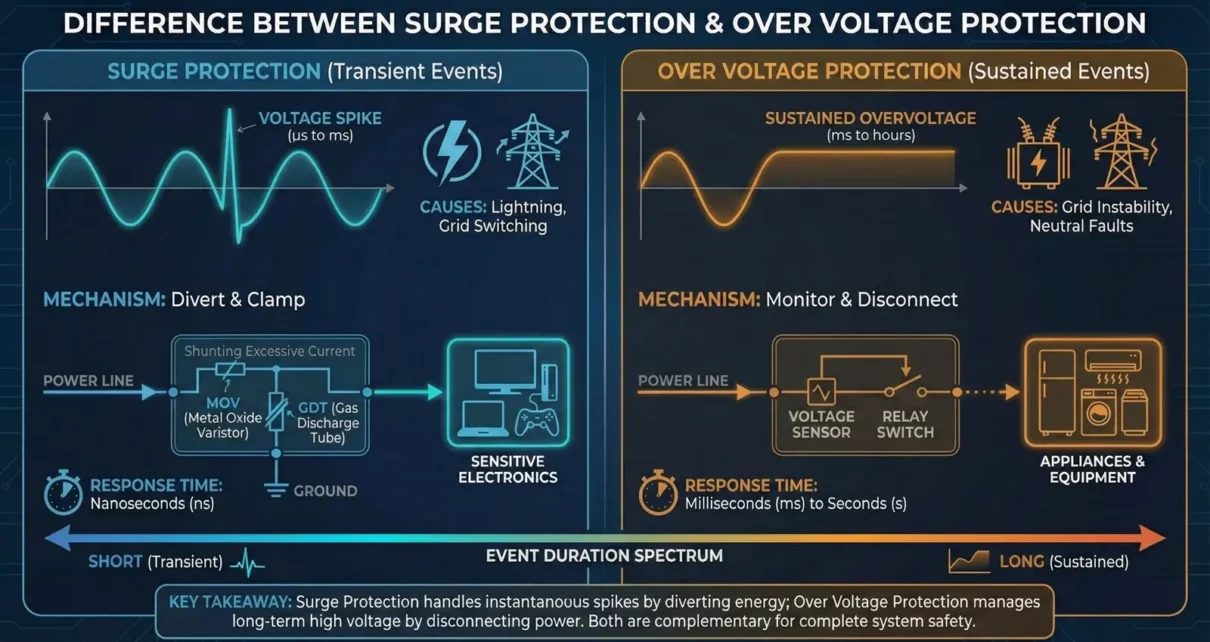
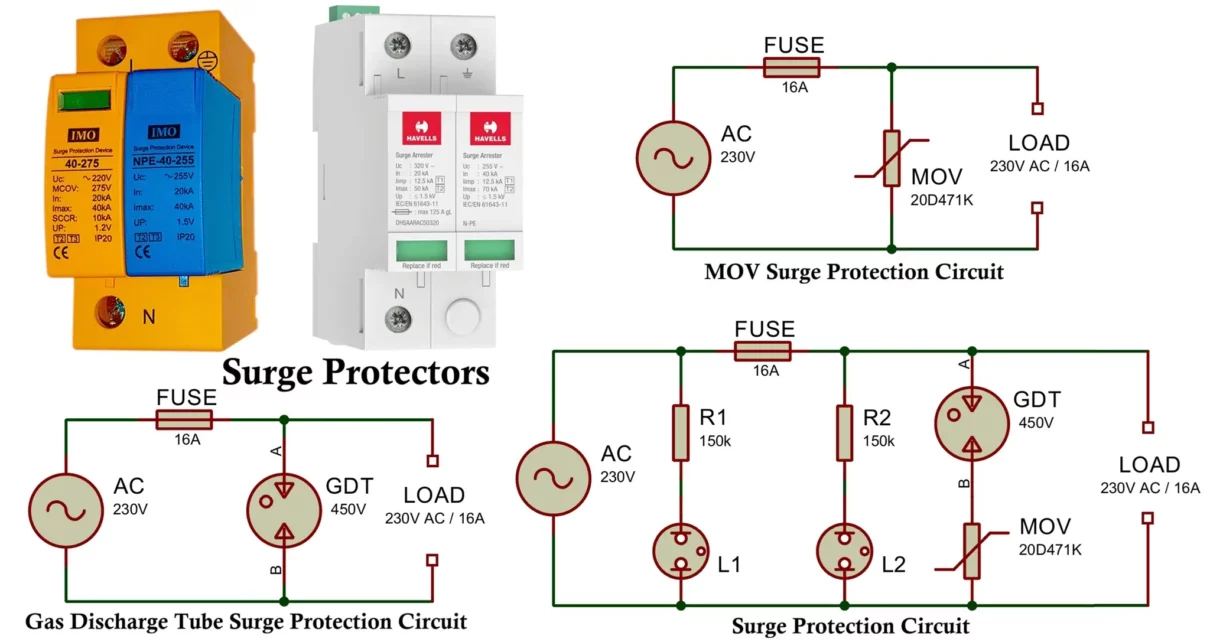
A surge protector is an electronic protection device designed to safeguard electrical and electronic equipment from voltage surges (transient overvoltage). A voltage surge is a sudden and short-duration spike in voltage that exceeds the normal operating voltage of a system. These surges may last from a few nanoseconds to milliseconds but can reach several kilovolts […]
Power Electronics
Difference Between Surge Protection and Over Voltage Protection
Understanding the difference between Surge Protection and Over Voltage Protection is essential for designing robust electronic systems, selecting the right protective components, and complying with safety and EMC standards. Modern electronic and electrical systems are increasingly sensitive to abnormal voltage conditions. With the widespread use of microcontrollers, SMPS power supplies, communication modules, and semiconductor devices, […]
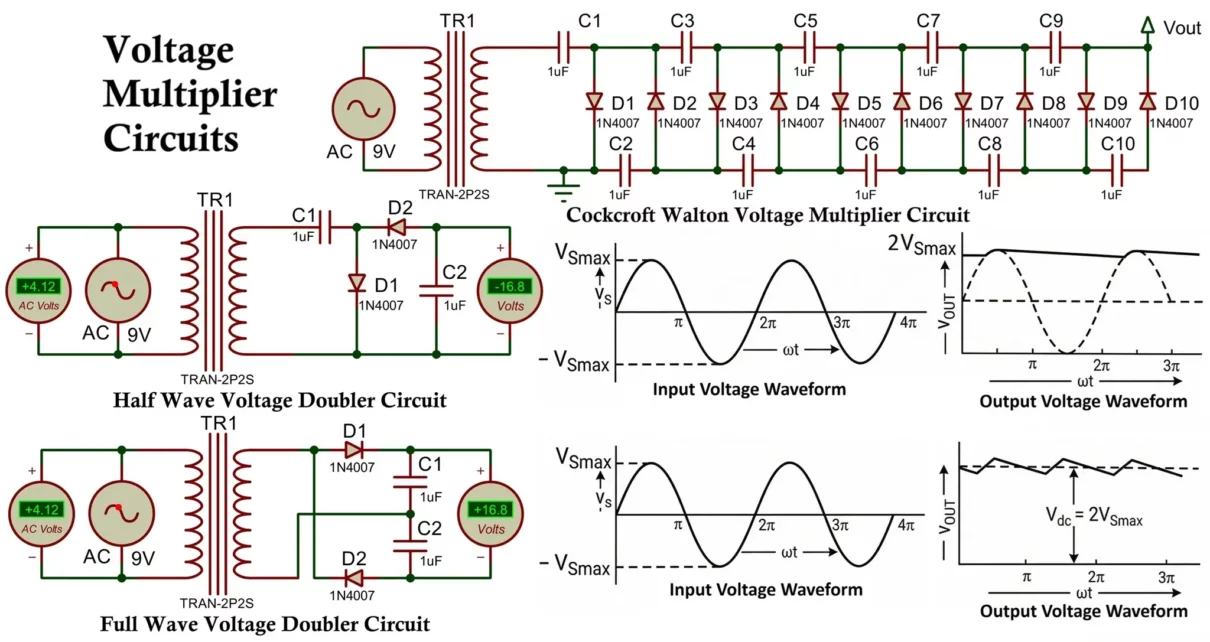
Voltage Multiplier Circuit Diagram, Working, Types and Applications
Voltage multiplier circuit forms a fundamental building block in high-voltage power supplies where the output voltage must be several times greater than the peak input voltage, yet the load current required is relatively small. Instead of using high-turn-ratio transformers which are large, expensive, and limited by insulation and core saturation constraints engineers often implement multipliers […]
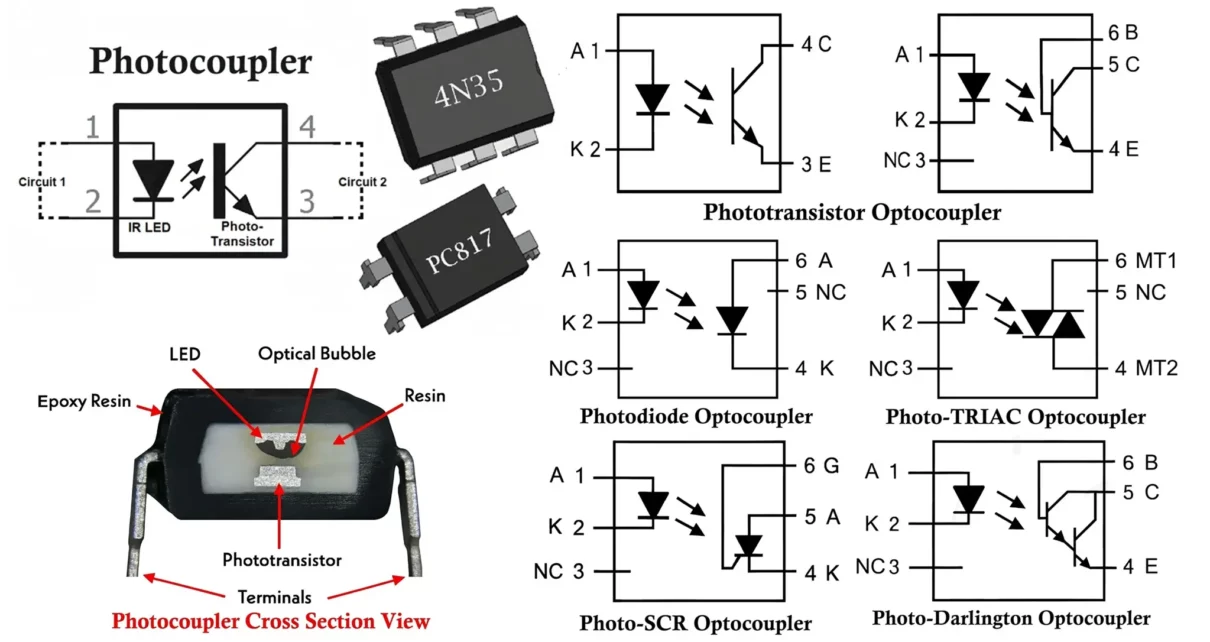
Photocoupler (Optocoupler / Optoisolator) – Construction, Working, Types & Applications
In modern electronics, signal isolation between different parts of a circuit is crucial for protection, noise reduction, and system stability. Optocouplers, also known as optoisolators, play a vital role in achieving this electrical isolation while allowing signal transmission. This article provides a thorough exploration of optocouplers (Optoisolator / Photocoupler), including their construction, working principles, advantages, […]
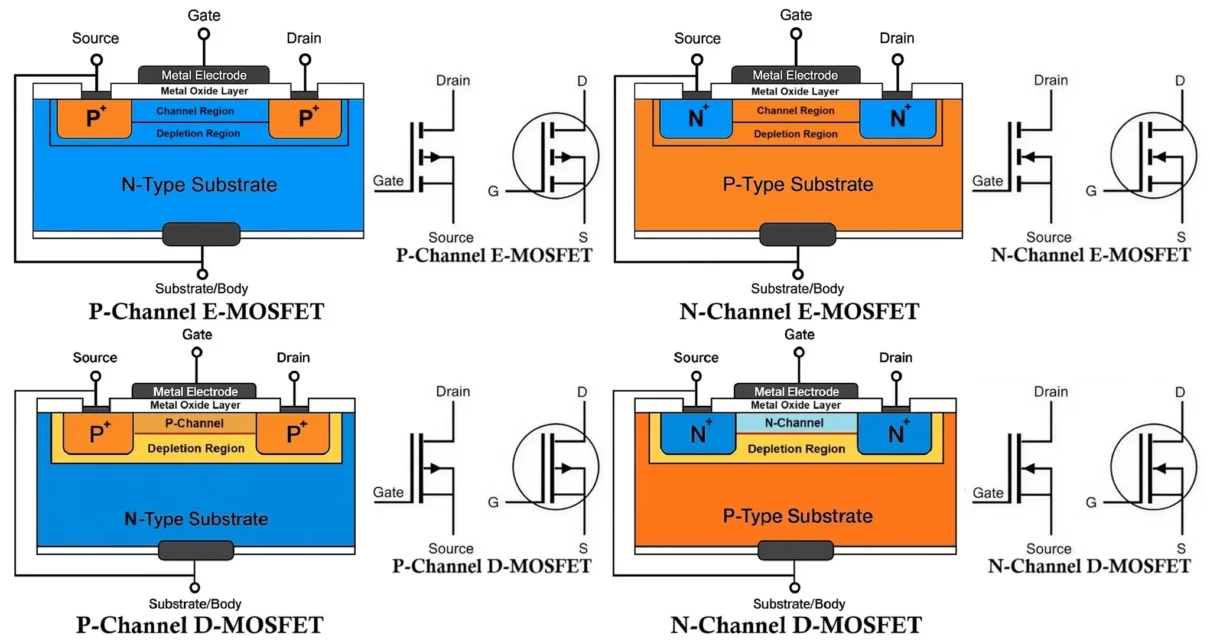
Difference Between D-MOSFET and E-MOSFET Explained
This article is on MOSFETs (Metal-Oxide-Semiconductor Field-Effect Transistor), covering the difference between D-MOSFET and E-MOSFETs with construction, working, advantages, disadvantages, and applications. MOSFETs are the most common types of Field Effect Transistors (FETs) in Modern electronics. It functions as a voltage-controlled device and delivers high input impedance along with fast switching speed. MOSFETs are the […]
Difference Between SCR, DIAC and TRIAC
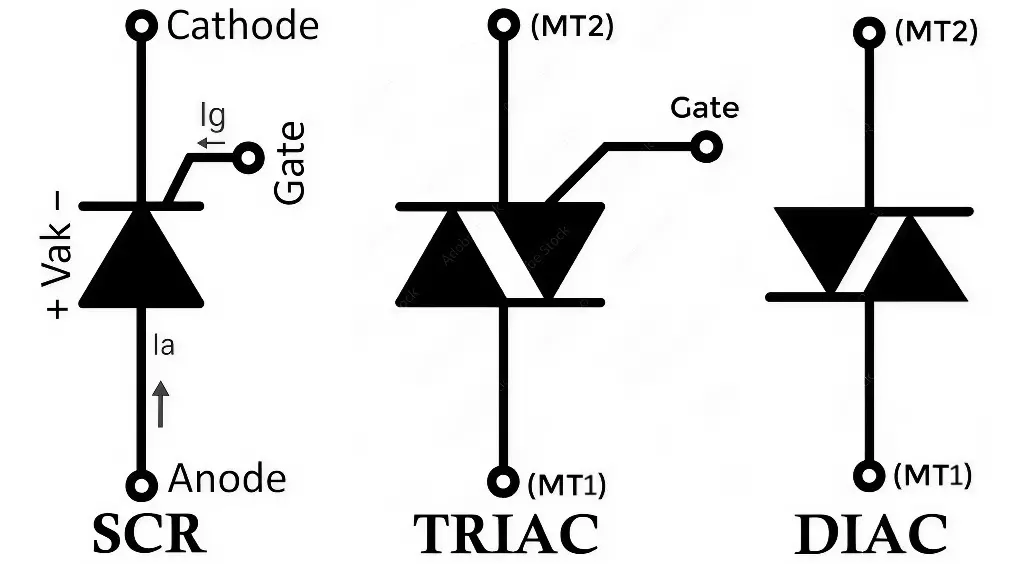
In power electronics, the SCR, DIAC, and TRIAC are three common semiconductor devices that are very useful in electric power control and conversion applications. Though they all belong to the thyristor family, their operation, structure, and applications differ significantly. Here’s a detailed explanation of SCR (Silicon Controlled Rectifier), DIAC (Diode for Alternating Current), and TRIAC […]